
Why Do Jowls Develop?
A New Anatomical Perspective on the Formation of Jowls
For decades, jowls have been explained simply as the result of gravity pulling facial fat downward.
Although intuitive, this explanation fails to answer several important questions.
Why do jowls consistently develop in a specific anatomical location?
Why does the jowl enlarge progressively even after the initial tissue descent?
And why is a distinct jowl fat pad formed instead of merely loose skin?
A more comprehensive explanation may lie in the interaction between the buccal fat pad, fascial septa, platysma, and the adaptive response of adipose tissue.
The Buccal Fat Pad Does Not Simply Descend
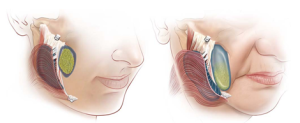
The buccal fat pad is enclosed by a fibrous septal system that connects adjacent facial structures.
With aging, repetitive facial movement, and gradual weakening of connective tissues, these septa become elongated rather than simply displaced.
As the septal system stretches, the mechanical load generated by the buccal fat pad is transmitted toward the lower face.
Instead of acting as a freely descending fat mass, the buccal fat pad behaves like a weight suspended by progressively lengthening fibrous septa.
This creates continuous traction on the superficial muscular layer.
Progressive Distension of the Platysma
The transmitted tension extends inferiorly toward the mandibular retaining ligament and the junction where the depressor anguli oris (DAO) merges with the platysma.
These structures normally stabilize the lower face.
However, continuous mechanical loading gradually stretches both the platysma and the overlying skin.
This process resembles the gradual elongation of a fabric under constant tension rather than an acute displacement.
Therefore, the early stage of jowl formation may be better understood as progressive soft-tissue distension, not simple tissue descent.
Muscle Attenuation Further Weakens Structural Support
As the platysma remains under chronic tension, the muscle undergoes gradual attenuation.
The muscle becomes thinner and loses its ability to resist gravitational loading.
Once muscular support decreases, the overlying skin is exposed to greater mechanical stress and gradually becomes lax as well.
Thus, skin laxity appears to be a secondary consequence of weakening muscular support rather than the primary cause of jowl formation.
Formation of the Jowl Fat Pad: An Adaptive Response?
One question remains unanswered by conventional theories:
Why does a localized fat pad develop within the jowl?
A possible explanation is that chronic mechanical stretching activates the biological response of subcutaneous adipose tissue.
If a subcutaneous fat compartment is present around the modiolus, prolonged mechanical tension may stimulate adipose-derived stem cells residing within that tissue.
These stem cells may differentiate into mature adipocytes, producing both:
- adipocyte hypertrophy (enlargement of existing fat cells)
- adipocyte hyperplasia (formation of new fat cells)
Rather than representing passive fat accumulation, the jowl fat pad may therefore be an adaptive response designed to reinforce an area where muscular support has progressively weakened.
A Compensatory Mechanism Rather Than Simple Aging
This concept suggests that the enlargement of the jowl fat pad is not merely degenerative.
Instead, it may represent a biological compensation.
As the platysma becomes elongated and loses tensile strength, surrounding adipose tissue expands in an attempt to redistribute mechanical forces and restore structural stability.
Ironically, this compensatory mechanism further increases tissue weight, generating additional traction on the already weakened platysma.
A self-perpetuating cycle may therefore develop:
- Septal elongation
- Increased traction from the buccal fat pad
- Platysmal distension
- Muscle attenuation
- Skin laxity
- Activation of adipose-derived stem cells
- Hyperplasia and hypertrophy of the jowl fat pad
- Increased tissue weight
- Further platysmal stretching
This positive feedback loop could explain the progressive enlargement of jowls with advancing age.
I am text block. Click edit button to change this text. Lorem ipsum dolor sit amet, consectetur adipiscing elit. Ut elit tellus, luctus nec ullamcorper mattis, pulvinar dapibus leo.