
I am raw html block.
Click edit button to change this html
Why Do Nasolabial Folds Develop?
They’re Not Simply Caused by Sagging Skin
One of the first signs of aging people notice when looking in the mirror is the appearance of nasolabial folds.
Many people believe that these folds develop simply because the skin loses elasticity and begins to sag. As a result, they often assume that dermal fillers or thread lifting can completely solve the problem.
However, nasolabial folds are far more than wrinkles caused by folded skin.
After performing facelift surgery for many years, I have come to believe that the nasolabial fold is an anatomical boundary created by both the structural framework of the face and the function of the facial expression muscles.
Nasolabial Folds Are a Normal Anatomical Structure
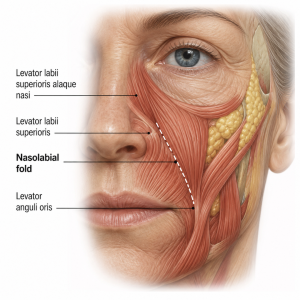
The nasolabial fold is the natural line extending from the ala of the nose (ala nasi) to the corner of the mouth.
It serves as an anatomical boundary separating the midface from the perioral region.
In other words, nasolabial folds do not suddenly appear with age.
They are a normal anatomical feature that exists even in young individuals.
As the aging process progresses, however, this natural boundary gradually becomes deeper and more prominent, eventually becoming one of the most recognizable signs of facial aging.
Facial Expression Muscles Shape the Nasolabial Fold
The nasolabial fold is not simply created by skin folding.
Instead, it is naturally formed through the activity of several facial expression muscles, particularly:
- Levator Labii Superioris (LLS)
- Levator Anguli Oris (LAO)
These muscles elevate the upper lip and contribute to normal facial expression, helping define the natural contour of the nasolabial fold.
As we age, another muscle—the Levator Labii Superioris Alaeque Nasi (LLSAN)—may also play an increasingly important role.
In my clinical experience, age-related changes in the resting tone and function of these muscles may contribute to the progressive deepening of the nasolabial fold.
Why Do Nasolabial Folds Become Deeper With Age?
When we are young, the facial expression muscles responsible for the nasolabial fold contract only temporarily—when we smile, speak, or make facial expressions.
As we age, however, the situation changes.
Repeated actions such as tightly closing the eyes, frowning, or instinctively protecting the face may gradually increase the resting tension of these muscles.
Over time, this repetitive muscle activity may contribute to making the nasolabial fold more defined and progressively deeper.
In my clinical experience, I believe this is one of the important factors that contributes to the deepening of nasolabial folds with age.
Facial Sagging Also Contributes
Muscle activity alone does not fully explain why nasolabial folds deepen.
As the face ages, several structural changes occur simultaneously, including:
- Facial bone remodeling
- Descent of the midfacial fat compartments
- Weakening of the facial retaining ligaments
- Loss of skin elasticity
These age-related changes work together to deepen and lengthen a fold that has always been part of normal facial anatomy.
In other words, nasolabial folds are best understood as the result of both facial muscle function and structural facial aging, rather than simply loose skin.
Why Can a Facelift Improve Nasolabial Folds?
Many patients ask,
“Why do my nasolabial folds improve after a facelift?”
The answer is not simply because the skin is pulled tighter.
In a Deep Plane Facelift, the tissues surrounding the Levator Labii Superioris (LLS) and Levator Anguli Oris (LAO) are carefully released and repositioned.
In my experience, this process may partially reduce excessive muscle tension while simultaneously restoring the descended midfacial tissues to a more youthful, superolateral position.
The combination of these effects often softens the nasolabial fold in a natural way, rather than making it disappear completely.
Why Don’t Nasolabial Folds Disappear Completely After Surgery?
Some patients wonder,
“Why is there still a slight nasolabial fold after surgery?”
The answer lies in the fact that the nasolabial fold is not merely a wrinkle—it is a normal anatomical structure closely related to the function of the facial expression muscles.
If the function of these muscles were completely eliminated, movement around the mouth would become unnatural, and normal facial expressions would be compromised.
For this reason, the goal of a well-performed facelift is not to erase every nasolabial fold, but to restore a youthful facial contour by reducing the excessive depth created by aging while preserving natural facial expression.
Conclusion
Nasolabial folds are much more than simple skin wrinkles.
They develop through the interaction of facial anatomy, facial expression muscles, and the structural changes that occur with aging.
For this reason, the key to successful treatment is not simply tightening the skin or adding volume with fillers, but understanding why the nasolabial fold has become deeper in the first place.
An accurate diagnosis allows treatment to be tailored to each individual’s aging pattern, leading to more natural, balanced, and long-lasting results.
I am text block. Click edit button to change this text. Lorem ipsum dolor sit amet, consectetur adipiscing elit. Ut elit tellus, luctus nec ullamcorper mattis, pulvinar dapibus leo.